

Close
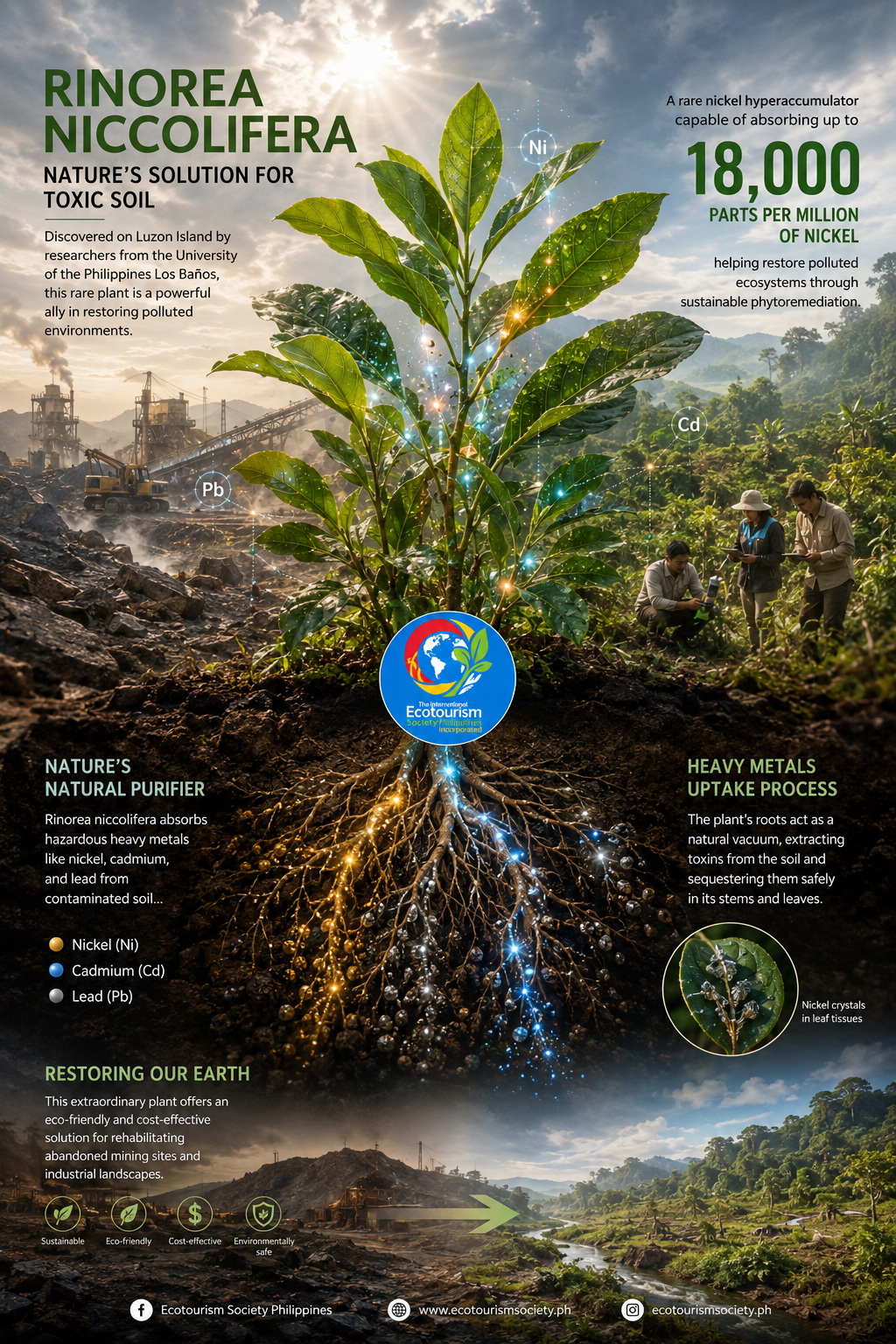
Environmental pollution caused by mining operations, industrial activities, and improper waste disposal continues to threaten ecosystems and human health across the globe. Heavy metals such as nickel, cadmium, lead, and mercury can remain in the soil for decades, contaminating water sources, destroying biodiversity, and limiting the recovery of natural environments. As scientists search for sustainable and eco-friendly solutions to these growing environmental concerns, nature itself has revealed one of its most remarkable answers through a rare plant species discovered in the Philippines — Rinorea niccolifera.
Discovered on Luzon Island by researchers from the University of the Philippines Los Baños (UPLB), Rinorea niccolifera has gained international scientific attention because of its extraordinary ability to absorb and tolerate extremely high concentrations of nickel from contaminated soils. This unique plant belongs to a special group known as hyperaccumulators — plants capable of taking in toxic heavy metals from the environment and storing them safely within their tissues without suffering harmful effects.
What makes Rinorea niccolifera exceptional is its ability to accumulate up to 18,000 parts per million (ppm) of nickel in its leaves. This concentration is significantly higher than what ordinary plants can tolerate, as most vegetation would quickly die or become severely damaged under such toxic conditions. Instead of being poisoned, Rinorea niccolifera thrives in metal-rich soils, making it one of the most promising natural tools for environmental cleanup and ecological restoration.
Scientists describe this natural cleanup process as phytoremediation — an innovative environmental technology that uses plants to remove, stabilize, or neutralize pollutants from soil, water, and air. Through phytoremediation, plants like Rinorea niccolifera act as biological filters or natural vacuums that absorb hazardous substances directly from contaminated environments. Once absorbed, these metals are safely stored in the plant’s stems, leaves, and tissues, reducing the spread of pollution and gradually restoring ecological balance.
Compared to conventional environmental cleanup methods such as mechanical excavation, chemical washing, or industrial soil replacement, phytoremediation offers several major advantages. Traditional methods are often expensive, labor-intensive, and environmentally disruptive. Heavy machinery can damage ecosystems further, while chemical treatments may introduce secondary pollutants into the environment. In contrast, phytoremediation is a low-cost, sustainable, and environmentally friendly solution that works with nature instead of against it.
The potential applications of Rinorea niccolifera are especially important in countries affected by mining-related environmental degradation. Abandoned mining sites frequently leave behind toxic landscapes where heavy metals continue to contaminate the soil and nearby water systems long after mining activities have ended. These polluted environments often become barren and unsuitable for agriculture, wildlife, or human settlement. Through the use of hyperaccumulator plants, scientists and environmental organizations may gradually rehabilitate these damaged areas by reducing heavy metal concentrations and supporting the return of vegetation and biodiversity.
Beyond mining rehabilitation, Rinorea niccolifera may also contribute to future developments in green technology and sustainable environmental management. Researchers are studying the possibility of “phytomining,” a process where valuable metals extracted by plants can later be recovered and recycled. This emerging concept could potentially transform certain contaminated areas into sustainable sources of metal recovery while simultaneously restoring ecosystems.
The discovery of Rinorea niccolifera also highlights the global importance of biodiversity conservation in the Philippines. The country is recognized as one of the world’s biodiversity hotspots, home to countless endemic species found nowhere else on Earth. However, many of these ecosystems face threats from deforestation, mining, climate change, and habitat destruction. Scientific discoveries such as this demonstrate why protecting forests and natural habitats is critical — not only for preserving wildlife, but also for uncovering natural solutions that may help address some of humanity’s most pressing environmental challenges.
In addition to its scientific significance, Rinorea niccolifera symbolizes hope in the fight against environmental degradation. Its remarkable ability to survive and heal polluted landscapes reminds us that nature possesses extraordinary resilience and untapped potential for restoration. As governments, researchers, and environmental organizations continue searching for sustainable methods to combat pollution and climate-related ecological damage, the role of phytoremediation and hyperaccumulator plants may become increasingly valuable in future environmental strategies.
The growing interest in green technologies, ecological restoration, and sustainable environmental practices underscores the importance of continued scientific research and public awareness. Supporting biodiversity conservation, funding environmental studies, and promoting eco-friendly restoration methods can help create healthier ecosystems and more sustainable communities for future generations.
Ultimately, Rinorea niccolifera is more than just a rare plant species. It represents the powerful connection between science and nature — a living example of how biodiversity can provide practical solutions for restoring polluted environments and protecting the planet. Through continued research, conservation, and environmental stewardship, discoveries like this may help pave the way toward a cleaner, greener, and more sustainable future.
REFERENCES:
University of the Philippines Los Baños (UPLB)
https://uplb.edu.ph/
ScienceDirect – Hyperaccumulator Plants and Phytoremediation
https://www.sciencedirect.com/topics/earth-and-planetary-sciences/hyperaccumulator
Wikipedia – Rinorea niccolifera
https://en.wikipedia.org/wiki/Rinorea_niccolifera
ResearchGate – Phytoremediation and Heavy Metal Hyperaccumulators
https://www.researchgate.net/publication/281647634_Phytoremediation_of_heavy_metals_Using_hyperaccumulator_plants
United States Environmental Protection Agency (EPA) – Introduction to Phytoremediation
https://www.epa.gov/
National Geographic – Environmental Restoration and Biodiversity
https://www.nationalgeographic.com/environment/
Britannica – Phytoremediation Definition and Applications
https://www.britannica.com/science/phytoremediation

Japan continues to demonstrate how practical innovation can turn everyday waste into valuable agricultural solutions. … Continue reading Japan Advances Circular Agriculture Through the Reuse of Plastic Packaging in Farming
April 29, 2026
MANILA, PHILIPPINES — The International Ecotourism Society of the Philippines Inc. (TIESPHI) continues to strengthen … Continue reading BUILDING BRIDGES FOR SUSTAINABLE TOURISM: TIESPHI EXPLORES MALAYSIA–PHILIPPINES ECOTOURISM AND SUSTAINABLE MICE PARTNERSHIP
August 21, 2026
Cebu, Philippines — As the nation reels from the devastating floods that struck Cebu, The … Continue reading 🌊 Cebu Floods: A Tragedy of Nature and Neglect — A Wake-Up Call for Real Environmental Action
November 10, 2025The 🌱 International Ecotourism Society (TIESPHI) is now open for membership registration to individuals, advocates, professionals, organizations, academic institutions, and community groups committed to promoting responsible and sustainable tourism.
As a member of TIES, you will gain access to:
Capacity-building programs, webinars, and learning sessions on ecotourism and sustainability
A global network of ecotourism professionals, organizations, and experts
Opportunities to participate in advocacy efforts, community-based initiatives, and conservation projects
Collaboration in promoting environmental stewardship and cultural preservation
TIES welcomes all who share the vision of protecting natural environments, empowering local communities, and supporting sustainable tourism development.
Be part of the global movement for responsible tourism—join TIES today 🌱!
 The International Ecotourism Society